The Coaching
Industry Has a
Mediocrity
Problem.
And the clients you want to work with know it. Senior leaders, elite athletes, high performers — they can identify a coach working from a script within 3 minutes. They don't hire a second session. This programme is for coaches who intend to be the exception.
— Free 100-Part Email Sequence — Join Below —
No cost. 100 emails. One principle per week. Unsubscribe at any time.
Same Tools.
Same Thinking.
Same Results.
The coaching industry has never been larger — and it has never been more indistinguishable. Thousands of coaches trained in the same models, using the same frameworks, asking the same questions, producing the same kind of progress that satisfies no one. Least of all the clients they're trying to attract.
The problem isn't competence. It isn't effort. It's a fundamental misunderstanding of what separates a coach clients seek out from a coach clients tolerate.
GROW has been taught to half a million coaches. OSCAR. CLEAR. The tools of the profession have become the ceiling of the profession. When every coach in the room uses the same framework, the client's only choice is price — and that is not a market position any serious practitioner wants to occupy.
- 01 The frameworks are overused and underpowered. GROW was designed for line managers coaching direct reports in the 1980s. It has been extended far beyond the context it was designed for — and the seams show.
- 02 Reflection without architecture produces insight without change. Coaches have been trained to ask powerful questions. They have not been trained to understand what produces durable psychological change — and those are different skills entirely.
- 03 Most coaching creates dependency, not capability. Clients who need their coach to sustain their progress are not coached clients — they are managed ones. The profession has confused a relationship that feels good with one that produces results.
- 04 Elite clients have been disappointed before. Senior executives and high-performing athletes have sat across from coaches who couldn't match their pace, their complexity, or their level. One mediocre experience produces a closed door — sometimes permanently.
- 05 Certification has replaced mastery as the standard. The industry has made it easier to become a coach than at any point in its history — and simultaneously harder to become an exceptional one. Most training stops precisely where the real work begins.
A New
Standard.
Entirely.
This is not a coaching certification. It is not an accreditation top-up. It is a complete psychological re-architecture of how you understand, conduct, and deliver coaching — built on 52 principles developed over three decades of practice at the highest levels of sport, business, and leadership.
The coaches who complete this programme do not compete on price. They do not struggle to find clients. They operate at a level the market recognises — and pays accordingly.
Before you can operate at world-class level, you must understand precisely where your ceiling is and why it exists. Phase One maps your Coach Type, identifies your blind spots, and benchmarks your current practice against 52 Principles framework. Most participants discover that their strengths and their limitations share the same root.
- Coach Type Assessment & full psychological profile
- Blind spot mapping across all 52 Principles
- Current practice audit against the world-class standard
- Identification of your three highest-leverage development areas
- Client outcome analysis — what your results reveal about your practice
- Personal development contract & programme roadmap
The models coaches learn tell them what to do. This phase teaches you why it works — and more critically, why it stops working. You'll move from framework literacy to psychological fluency: understanding the laws of identity, capability, belief, and change that operate beneath every coaching conversation you'll ever have.
- Identity vs behaviour — why surface change never holds
- The capability transfer model — the only measure that matters
- Motivation vs capability — why coaches conflate them
- The psychology of sustained change in high performers
- Resistance, avoidance and the coach's role in both
- What elite clients require at the psychological level
The longest and most intensive phase. 52 Principles are worked in thematic clusters — not as concepts to be understood, but as tools to be applied. Each cluster session includes case analysis, live coaching demonstrations, and supervised practice. You leave each cluster with the principle integrated, not merely learned.
- Cluster 1: Identity, Belief & Self-Concept
- Cluster 2: Capability, Motivation & the Transfer Problem
- Cluster 3: Resistance, Avoidance & the Shadow
- Cluster 4: Pressure, Performance & Elite Environments
- Cluster 5: Relationships, Power & the Coaching Dynamic
- Cluster 6: Obsolescence — making yourself unnecessary
This phase focuses on application at the highest level. What does coaching look like when the client is a C-suite executive, an Olympic-level athlete, or a founder managing a crisis? How do you hold your practice under the specific pressures elite environments generate? How do you command the fees, the respect, and the referrals that world-class practice produces?
- Coaching senior executives and C-suite leaders
- Performance coaching in elite sport environments
- Crisis coaching — maintaining clarity under pressure
- Commercial positioning — the The Performance Coach's market
- Referral architecture — how great clients find great coaches
- Fees, positioning and the psychology of premium
The final phase brings everything together. Live supervision sessions with Ben Benson, a portfolio review of your coaching work across the programme, and the formal assessment for the The Performance Coach designation. Coaches who complete this phase are equipped — and recognised — to operate at the level the programme has built them for.
- Live group supervision with Ben Benson
- Individual coaching portfolio review
- Formal The Performance Coach assessment
- Performance Capability The Performance Coach designation
- Programme alumni network access
- Ongoing CPD pathway and advanced programme eligibility
The next cohort is forming. Register your interest below — programme dates, investment details and intake requirements will be sent directly to you.
No commitment required. Programme details sent within 48 hours.
Six Principles.
A Glimpse
of Fifty-Two.
52 Principles are the intellectual foundation of the The Performance Coach — and of the book that preceded it. What follows is six. They are not the most dramatic. They are the ones most likely to show you, specifically, what you have not yet seen.
Your client doesn't resist change. They resist becoming someone they don't yet recognise. Until you work at the identity layer, all behavioural coaching is temporary — and your most effective sessions leave no lasting trace.
Motivated clients who lack capability fail visibly. Capable clients who lack motivation fail quietly. Most coaches treat both with the same intervention. The The Performance Coach diagnoses first — always.
The coach who prioritises the relationship over the result has confused the means with the end. Clients leave feeling understood — and unchanged. This is The Empath's specific and predictable blind spot.
The Catalyst creates energy without infrastructure. Clients leave sessions inspired, return the following week unchanged. Momentum without mechanism always collapses — and always does so just after the coach feels the session went brilliantly.
Insight produced inside a coaching session that cannot survive outside it is not coaching — it is conversation. The distinction is everything. The world-class standard measures only what leaves the room with the client.
The finest measure of coaching effectiveness is not client dependency — it is the precision with which you have worked yourself out of a job. Obsolescence is the goal. Everything else is a coaching relationship that serves the coach.
Forty-six more await. Begin the free email sequence to receive them one at a time, each week.
Start Reading
Like a
The Performance Coach.
The email sequence does not summarise the book. It reveals the architecture beneath it — week by week, principle by principle. Coaches who complete it consistently report the same thing: they buy the book not because they were sold to, but because they recognise exactly what they have been missing.
No cost · No obligation · Unsubscribe at any time
Which Coach
Are You?
Three decades of working with coaches across business, sport, and life revealed an unavoidable pattern. Every coach, regardless of training, experience, or seniority, defaults to one of three psychological orientations. Each carries extraordinary strengths. Each carries a specific and predictable blind spot. And in every case, that blind spot is precisely where their best clients go elsewhere.
Systematic. Framework-driven. Finds security in structure. Believes the right process produces the right result — and is correct, up to a point that structure alone cannot reach.
BLIND SPOT REDACTEDRelationship-first. Deeply attuned. Creates extraordinary psychological safety. Clients feel genuinely seen — which is essential, but is not the same as changed.
BLIND SPOT REDACTEDEnergetic. Intuitive. Inspires action at a level other coaches cannot match. Moves clients powerfully — but movement without permanent architecture rarely lands anywhere that holds.
BLIND SPOT REDACTEDComplete the 20-question diagnostic to identify your type — and the specific blind spot that is currently limiting your practice and your client quality.
Results unlocked upon sign-up — free access
Your Coach
Type Is Ready
You have answered all 20 questions. Enter your details below to reveal your Coach Type — and see the specific blind spot currently limiting your practice and your client quality.
Free. Your full diagnostic report follows immediately on screen — then arrives in your inbox as your first email.
The Book
That Started
This.
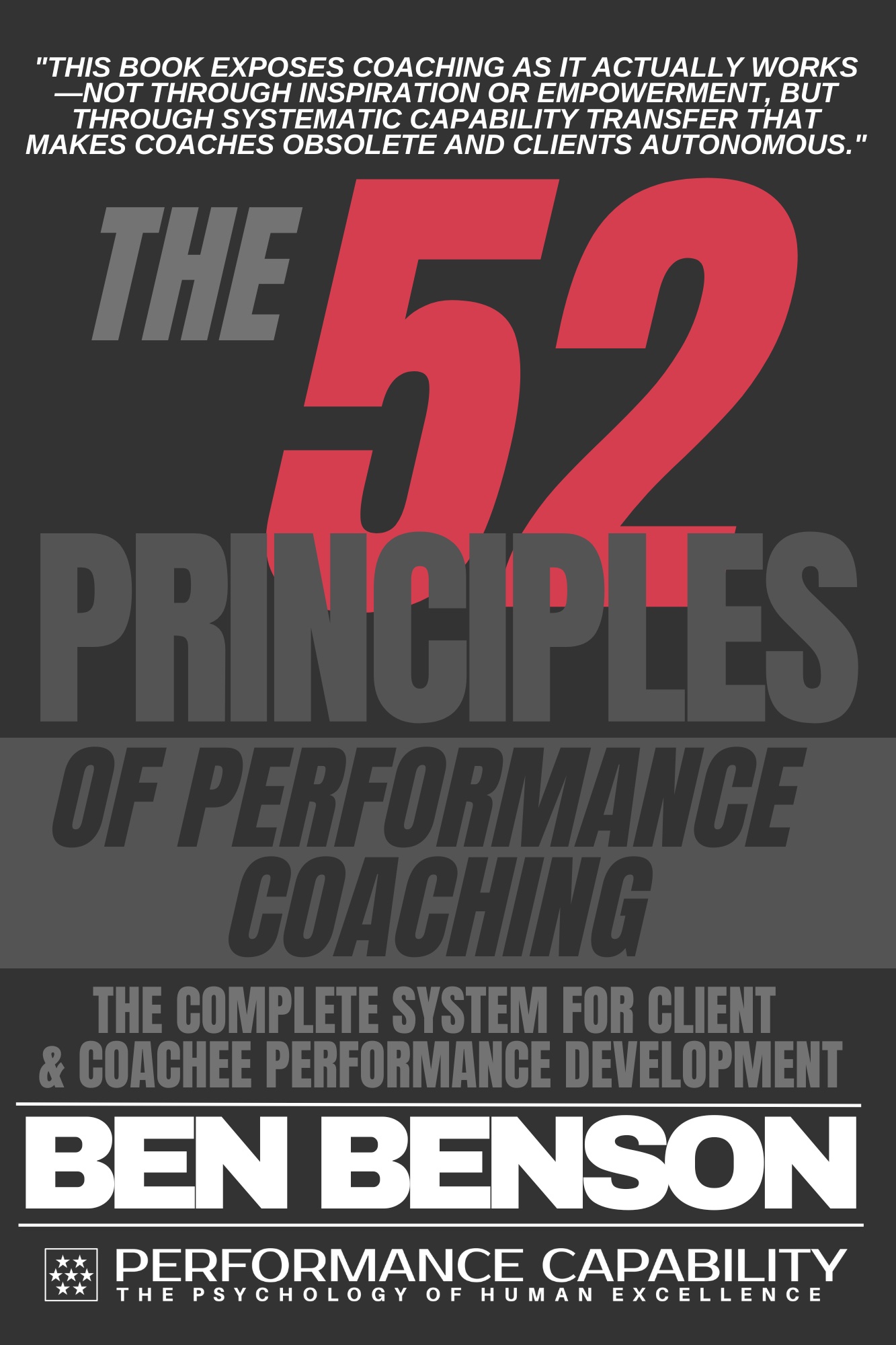
52 Principles of Performance Coaching is the intellectual architecture that underpins the The Performance Coach. It is not a how-to manual. It is the psychological framework that explains why everything else in coaching works — and where, precisely, it stops working.
Written in the tradition of Ben Benson — psychologically rigorous, historically grounded, directly instructional — it addresses coaches as serious practitioners, not students. Each of 52 Principles follows a consistent structure: the principle itself, the application, the shadow, the counterbalance, and the edge.
Over 105,000 words. Available now in print and digital. The free email sequence delivers the principles one at a time — 100 emails, weekly. The book delivers all 52 without waiting.
What Coaches
Say
"I've read everything available on coaching. This is the first framework that explained what was actually happening in my best sessions — and why my average ones looked the same but produced nothing. The Coach Type diagnosis alone was worth three years of supervision."
"I was The Empath. I knew it the moment I saw the description. My clients loved working with me and I couldn't understand why the results weren't matching the relationship. The 17th Principle described my practice with uncomfortable precision. I've not coached the same way since."
"I coach professional athletes and the gap between what I was doing and what this framework makes possible is significant. The capability transfer model in particular — it's the clearest articulation I've encountered of why some athletes perform under pressure and others don't."
The Programme
Begins Here.
Most coaches spend their entire career competing for clients who would have preferred someone better. The Performance Coach exists to ensure that when an exceptional client is looking, it is you they find — and it is you they do not leave. Register below. Programme details, cohort dates, and investment information will follow within 48 hours.
You will also receive the free 100-part email sequence and your Coach Type diagnostic results. Delivered via GoHighLevel.